Ranking Scholars When Journals and Citations Matter
Abstract
Scholarly evaluation must reconcile two imperfect signals: the ex-ante judgment reflected in journal prestige and the ex-post impact measured by citations. We develop a unified axiomatic framework that integrates an ordinal journal list with cardinal citation counts and characterize two complementary families of ranking rules. Journal-based Bean-Counting rules treat list placement and citations as substitutes or complements through citation thresholds. Citation-based Asymmetric Constant Elasticity of Substitution (CES) aggregators reward publication breadth inside the journal list and citation depth outside it. Applied to 4,722 economists at universities that appeared in the QS Top 100 between 2023 and 2026, the two families produce sharply different rankings across fields, especially in microeconomic theory and economic history. Adjusting for field differences in citation rates leaves the overall clustering structure largely stable, though within-field robustness varies across methods.
Why measure scholarly impact using both journal prestige and citations?
Journal placement provides an ex-ante signal of research quality, whereas citations capture ex-post scholarly impact. Because each contains information the other omits, and disciplines place different weights on them, we integrate both within a unified framework comprising two complementary families of scholar-ranking rules and an interactive tool that shows how rankings change under alternative evaluative priorities.
Two complementary families of scholar-ranking rules
Our framework turns this tension into a ranking-design problem by offering two complementary approaches:
- Bean-Counting — starts from journal placement and uses citation thresholds to extend or restrict credit across publications.
- CES — starts from citation impact and uses journal-dependent elasticities to reward publication breadth inside recognized journals and citation depth outside them.
Sample
Scholars from the economics departments of universities that appeared in the QS Top 100 between 2023 and 2026.
Rules
Bibliometric baselines (h-index, i10, Euclidean, citation counts) alongside the Bean-Counting and CES families.
Classification
Filter by field — explore in the Ranking page.
Navigate the project
What the rankings reveal
We apply both families to 4,722 economists at universities that appeared in the QS Top 100 between 2023 and 2026, through three exercises: First, we compare the scholar rankings generated by all rules in both families and benchmark them against conventional metrics. Second, we examine how field-level rankings vary across rules. Third, we assess the sensitivity of each rule to field-specific citation rescaling. Five figures summarize the main findings.
How the rules relate to one another
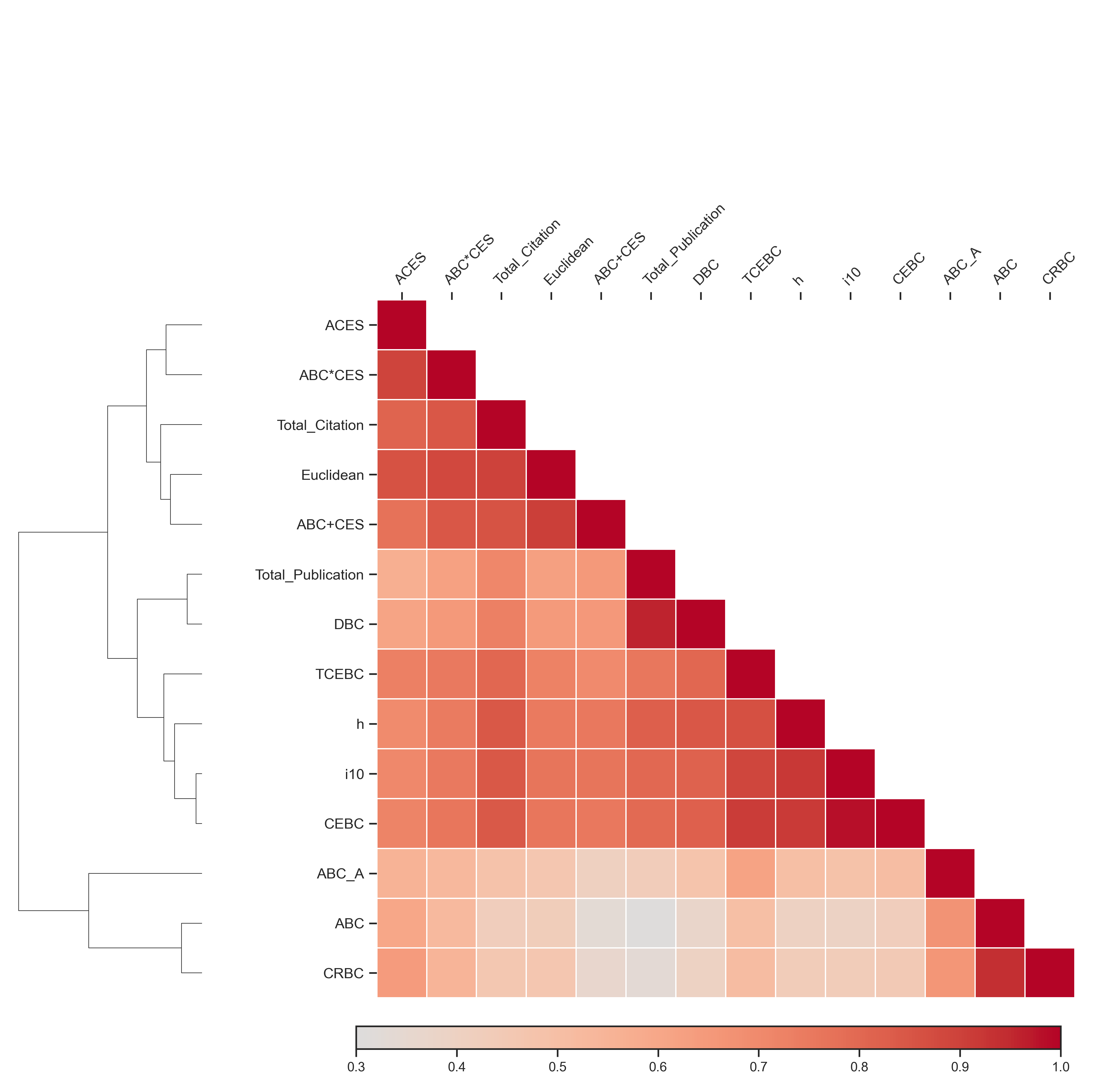
A clustered heatmap of Kendall rank correlations across all rules and benchmarks. Journal-based and citation-based metrics capture distinct dimensions — the h- and i10-indices correlate strongly with each other yet diverge sharply from ABC. The Bean-Counting family splits into two clusters (strict ABC/CRBC vs. broader DBC/CEBC/TCEBC), while the three CES rules form a coherent cluster of their own, closely aligned with the Euclidean index yet clearly separated from the strict journal-based rules.
Field rankings across every rule
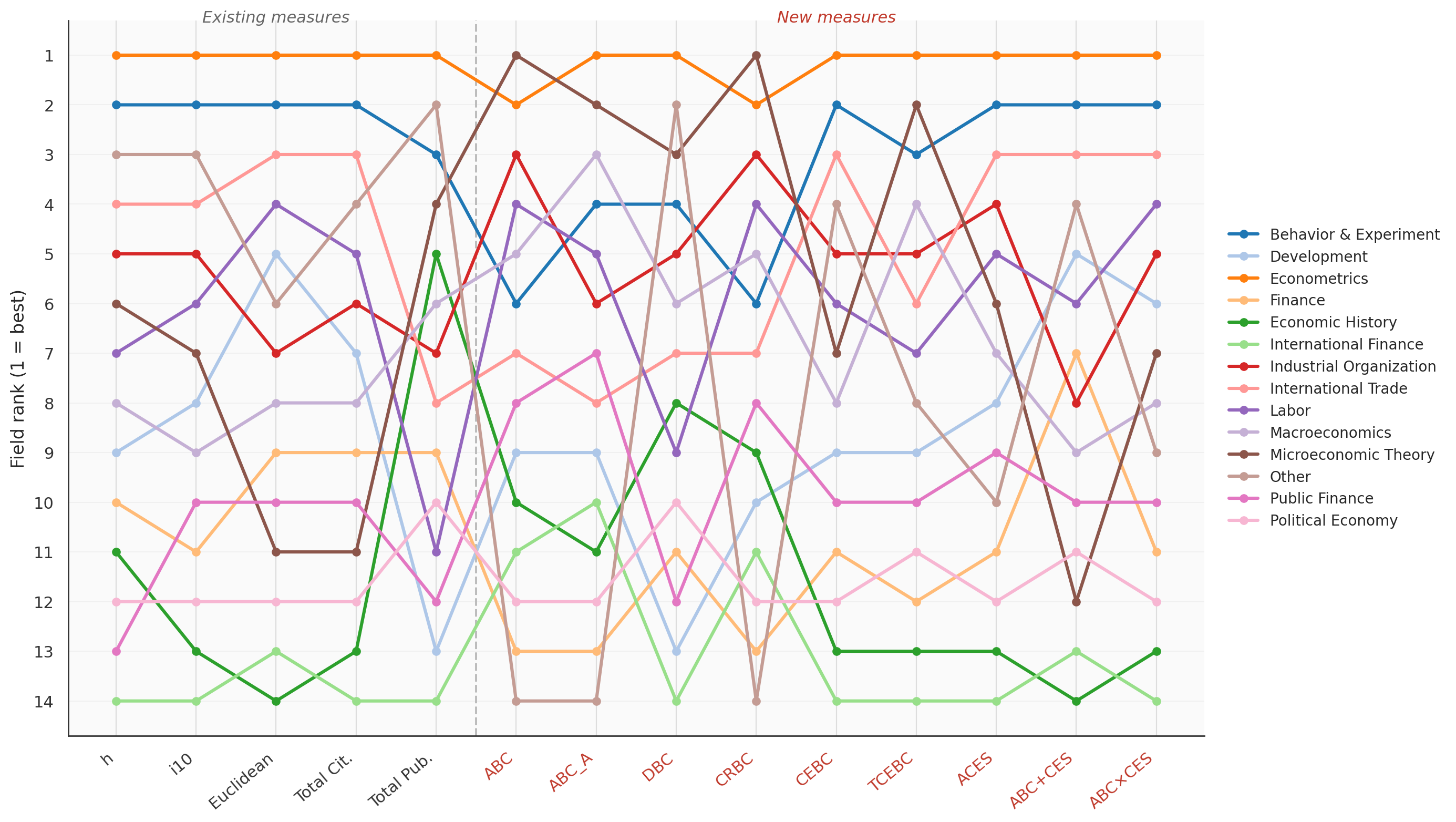
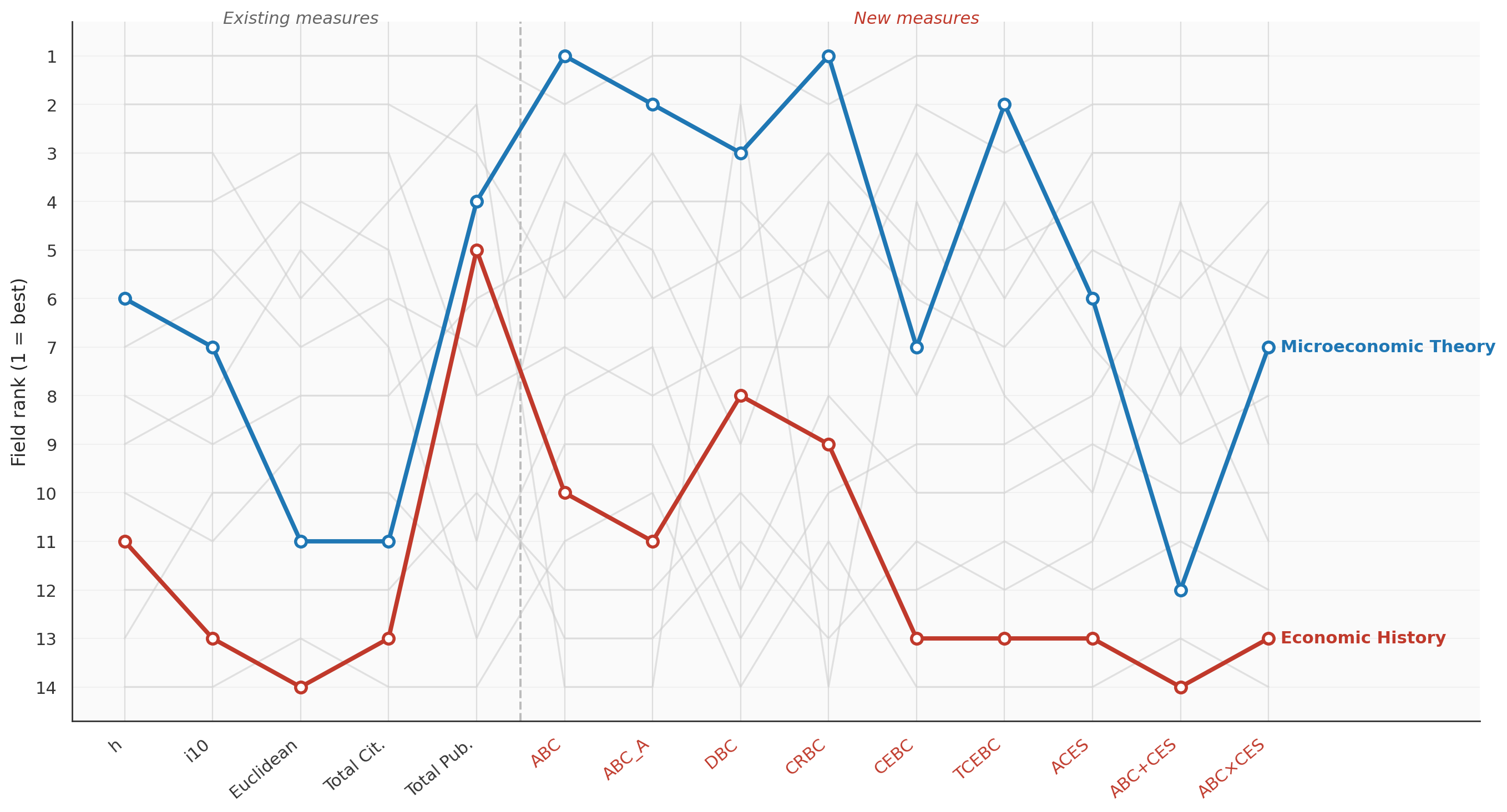
Average field rankings under all 14 fields, traced across each rule. Restricting to single-field scholars (3,416 scholars, 72.34% of the sample), the lines show which fields hold their position and which swing with the choice of rule.
The top-ranked and bottom-ranked fields
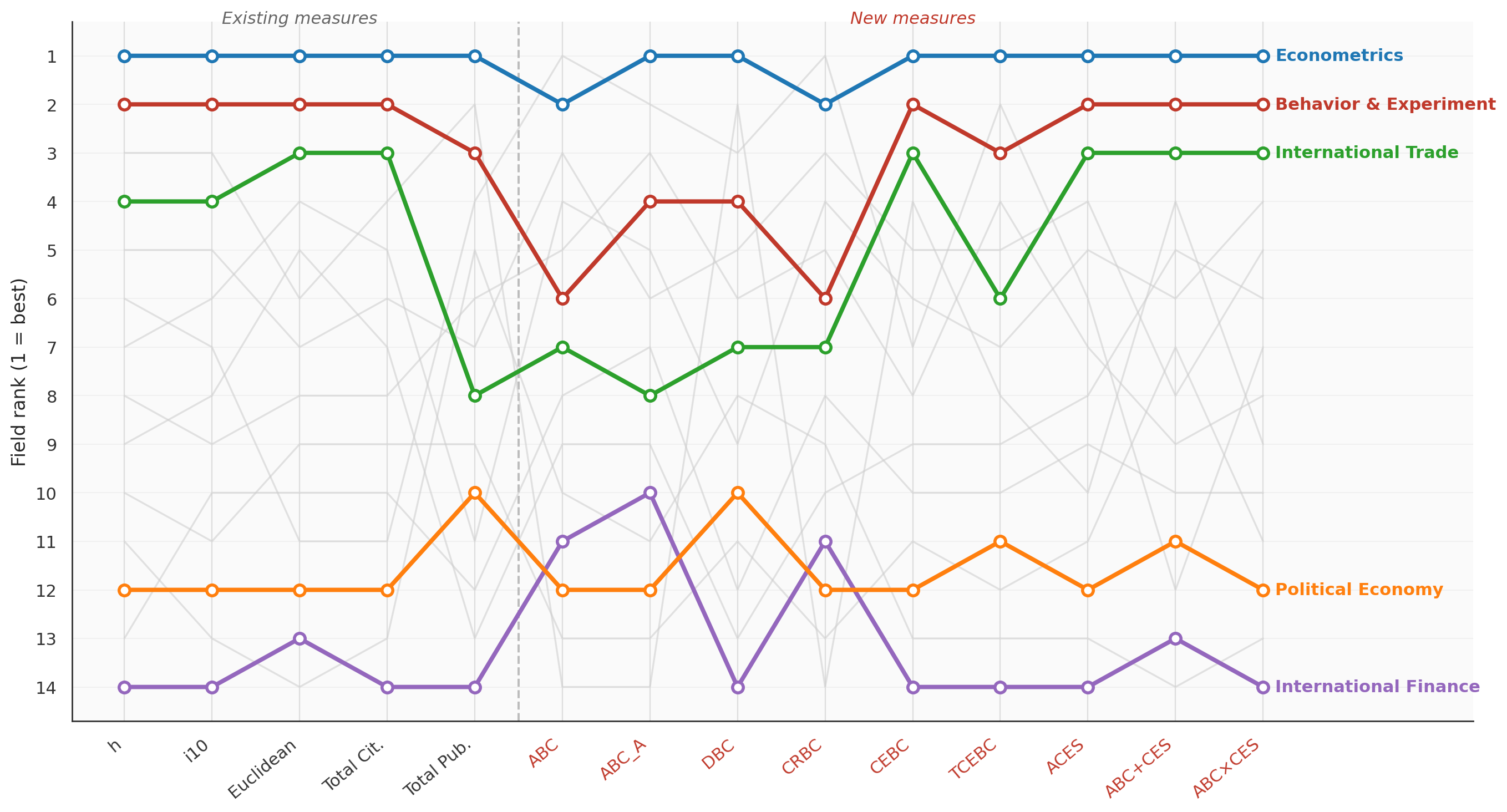
The three top-ranked fields — econometrics, behavior & experiment, and international trade — stay near the top across rules, with econometrics almost always leading. At the other end, international finance and political economy remain consistently near the bottom.
The least stable fields
Microeconomic theory and economic history swing the most, but for different reasons. Theorists rank first under the strict journal-based rules ABC and CRBC but fall to ranks 11–12 once citations receive greater weight; economic historians rank highly under publication-volume rules but fall to the bottom under citation-weighted ones.
Robustness to citation rescaling
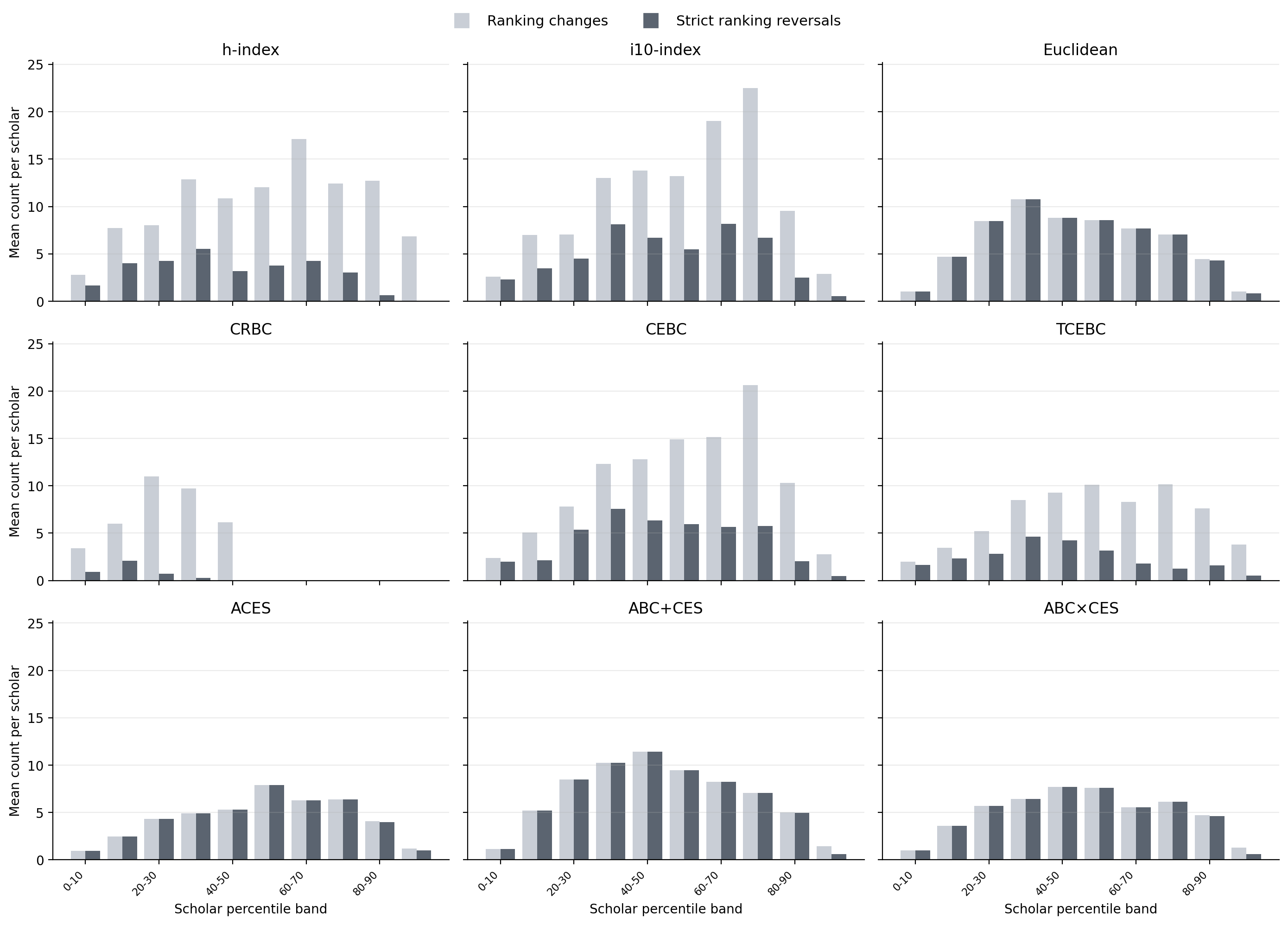
Using econometrics (315 single-field scholars) as an illustration, we examine within-field ranking instability after rescaling each publication’s citations by its field’s average citation count. CRBC is substantially more robust than any other citation-sensitive rule, leaving roughly 56% of scholars entirely unaffected. Because its citation threshold applies only to Top Five publications, it is closely aligned with ABC. Among the remaining rules, continuous aggregators such as ACES and ABC×CES are less sensitive to rescaling than measures that impose citation thresholds on all publications, including the h-index, the i10-index, and CEBC.